
Auctions & post-sale
Run the sale. Finish it properly.
Every sale format your business needs, with checkout, shipping, issues, and seller payouts connected to the same order.
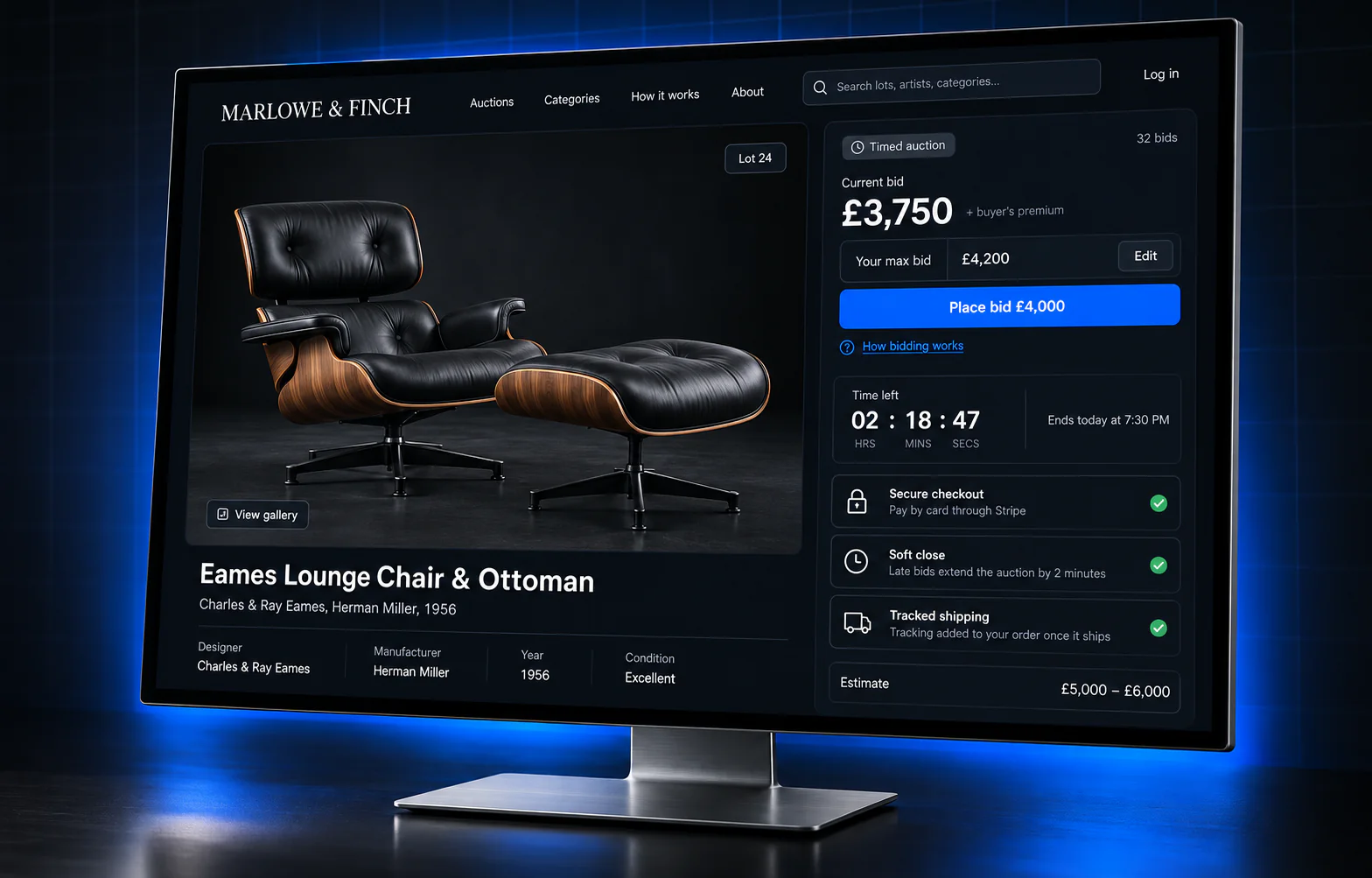
- Sale formatTimed here. Choose the format per sale, not per platform.
- Proxy biddingBuyers set a maximum bid instead of watching the clock.
- Soft closeLate bids extend the auction instead of ending it on the clock.
Run the sale
Pick the format that fits each sale
Set the rules once and every auction inherits them.
| Format | How it works | Often used for |
|---|---|---|
| Timed | Bids rise until the clock runs out, with proxy bidding and soft close. | Regular online sales, e.g. a monthly catalogue |
| Dutch | The price starts high and falls until a buyer accepts it. | Letting the market find the price quickly |
| Sealed bid | Bids stay hidden from everyone until the reveal. | Sales where bidders shouldn’t see each other’s bids |
| Fixed price | A set price with Buy Now, or offers with minimum and auto-accept thresholds. | Stock you sell alongside your auctions |
| Live and simulcast | An auctioneer console runs the event. | Flagship events |
Bidding rules every sale inherits
- Proxy bidding
- Soft close: late bids extend the auction
- Reserves and increment ladders
A second chance for unsold lots
- Deal rooms offer unsold lots to underbidders
- Offers with minimum and auto-accept thresholds
- Commission concessions within limits you set
Sealed-bid options and live events
- Sealed-bid options
- First-price, second-price, or multi-unit. Bids stay hidden from everyone until the reveal.
- Live events
- Live and simulcast events run from an auctioneer console, with a tamper-evident audit trail.
Complete the sale
Everything after the hammer stays on one order
Winning the lot creates the order. Payment, delivery, issues, and the seller’s payout attach to it — so your team works from one record.
Example order
Lot 24 · Eames Lounge Chair & Ottoman
- PaymentPaid by card through StripePaid
- FeesBuyer’s premium, commission, and tax calculated per lotCalculated
- ShippingCarrier and tracking number attached to the orderShipped
- IssuesThe buyer can report a problem from this orderNone open
- Seller payoutScheduled from the order once the buyer paysScheduled
Who does what
What Hammerd runs for every order, and what you set for your business.
| Area | Hammerd handles | You configure |
|---|---|---|
| Payment | Card checkout inside the sale flow, through Stripe | Your Stripe payment setup, in up to 10 currencies |
| Fees | Buyer’s premium, commission, and tax calculated per lot | The buyer’s premium and commission you charge |
| Delivery | Tracking kept on the order for you and the buyer | Platform shipping, or your own carrier and tracking number |
| Issues | Buyers report problems from their order | Resolve disputes and refunds in one place |
| Payouts | Seller payouts scheduled from the order, and consignor statements with sales, commission, and payouts | Your consignors’ terms, set in their seller agreements |
| Risk | Fraud alerts and AML review on high-value sales | Identity checks for bidders and sellers, switched on where you need them |
One system
Before, during, and after the sale
Each part runs on the same records, so nothing is re-keyed between teams or tools.
Before the sale
Sellers & supply
Bring in sellers, sign agreements, verify identities, and approve listings.
ExploreBefore the sale
Audience & marketing
Grow your own buyer lists, email them when it matters, and publish articles.
ExploreThe sale and after
Auctions & post-sale
Run every sale format, then take payment, ship, resolve issues, and pay sellers.
You’re hereSee your next sale run through Hammerd
Tell us what you sell and how, and we’ll show you the formats and flow that fit.
Prefer to talk first?
Leave your work email and we’ll walk you through it.
We’ll reply by email with times that work.